




How To Choose The Best Professional Hair Cutting Shears


.jpg)
The Complete Guide To Professional Hair Cutting Shears
As a salon professional, shears for cutting and styling are vital to your business. That’s why it’s important to know the basics about shears before you buy. High- quality shears are an investment that will help you cut smoothly and confidently for years to come, so you’ll want to think about the top options for your clients that fit within your budget. Do you want hairstyling shears in a traditional design or those with modern ergonomic features? Are you looking for the best shears backed by superior steel and elite workmanship? Read on for some clear shear advice to help you make the right choice.Materials and Costs
Depending upon your budget and needs, you can choose between low-cost, moderately priced and premium shears. Don't know where to start? Fromm's Shear Artistry line of shears that offers beautiful design and best-in-class performance at each price point.
Premium Shears
- Often handmade, starting at around $200
- Crafted from German or Japanese steel
-
Made from high-quality steel for longer life and less frequent servicing
Moderately Priced Shears
- In a price range from $60 to $200
- Usually made from high-quality German steel
- Commonly crafted in Asia or Pakistan
-
Dependable and longer lasting when made of quality steel
Low Cost Shears
- Priced in the $10 to $60 range
- Machine-manufactured with lower-quality steel
- Have a lower grade of workmanship
-
Last about three months with regular use
All professional shears are made of steel. Premium shears with quality steel blades from Germany and Japan cost more but offer greater value over time. Workmanship is another factor in determining product quality, and that’s why buying from a reputable maker helps to ensure the blades are finished properly.
It’s important to know that low-cost shears with a serrated-edge blade are machine-sharpened during manufacturing. They cannot be sharpened after purchase and will eventually wear out.
Types of Blades on Professional Shears
The quality of a pair of professional shears is affected by the steel used to manufacture the blades. Germany and Japan are two countries offering a higher grade of steel for making the three main types of blades - convex, semi convex and beveled. Convex blades support your advanced techniques with smoother, sharper cutting. Semi convex blades offer durability, while beveled edge blades are an older design, which is often found on less expensive shears. Typically, Japanese steel (aka convex) are the trusted metal when looking for professional hair cutting shears as they resist corrosion and keep their edge longer.
Convex
- Has a slight curve on the blade edge that forms an angle
- Also called a Japanese-style blade
- Requires more care than other blade types
- Comes with a very sharp edge
-
Supports detail-oriented and advanced cuts, finishing cuts and chipping
Semi Convex
- A versatile combination of convex and beveled edge blades
- Features a narrower beveled edge with a slight curve
-
Sharper and more durable than a beveled edge blade
Beveled Edge
- Cuts well but requires more force than a convex blade
- Offers a flat-surface cutting edge
- Durable due to its edge thickness
- Not designed for advanced techniques, such as slide-cutting
-
Best for scissor-over-comb blending
.jpg)
shear sizing
Aside from buying right or left handed hair cutting shears, sizing is the next most important feature to consider. Select a blade length on your professional shears that coordinates with the length of your hand, the technique you’ll be performing, and your desired level of control. A shorter blade could support fine, precision cutting with greater control, while a longer blade could cut hair more efficiently. Many professionals own shears with different blade lengths to meet varying needs.
- Blade lengths range from 4 to 7 inches
- Shorter blades between 4.0 and 5.5 inches are often used for intricate cuts, touchups or cutting close to the skin
- Longer blades over 6.0 are preferred for bobs, slide cutting, scissor-over-comb and cutting thick hair and require more material making them heavier
- A 5.5-inch blade is commonly used in beauty schools
A strong perimeter paired with technical layers, using short and long shears.
Handles and Features on Hair Cutting Shears
Choose hair cutting shears with handles that provide your preferred design and features. With a straight handle, the finger and thumb holes will be directly opposite each other. With offset handles, the finger and thumb holes will be in offset positions.
Keep in mind a handle with an ergonomic design, like the Fromm Defy and Invent Shears, can benefit both your technique and comfort. Since your thumb plays a major role in cutting, shears with a thumb rest also reduce fatigue as you perform repetitive movements. And for quieter cutting, bumpers can be placed on the shears.

Straight Handle Shears
- Also known as opposing handle or opposing grip
- The oldest style of handle
-
Not an ergonomic design

Offset Handle Shears
- Most popular type
- Ergonomically designed to reduce fatigue
-
Includes the crane-style design
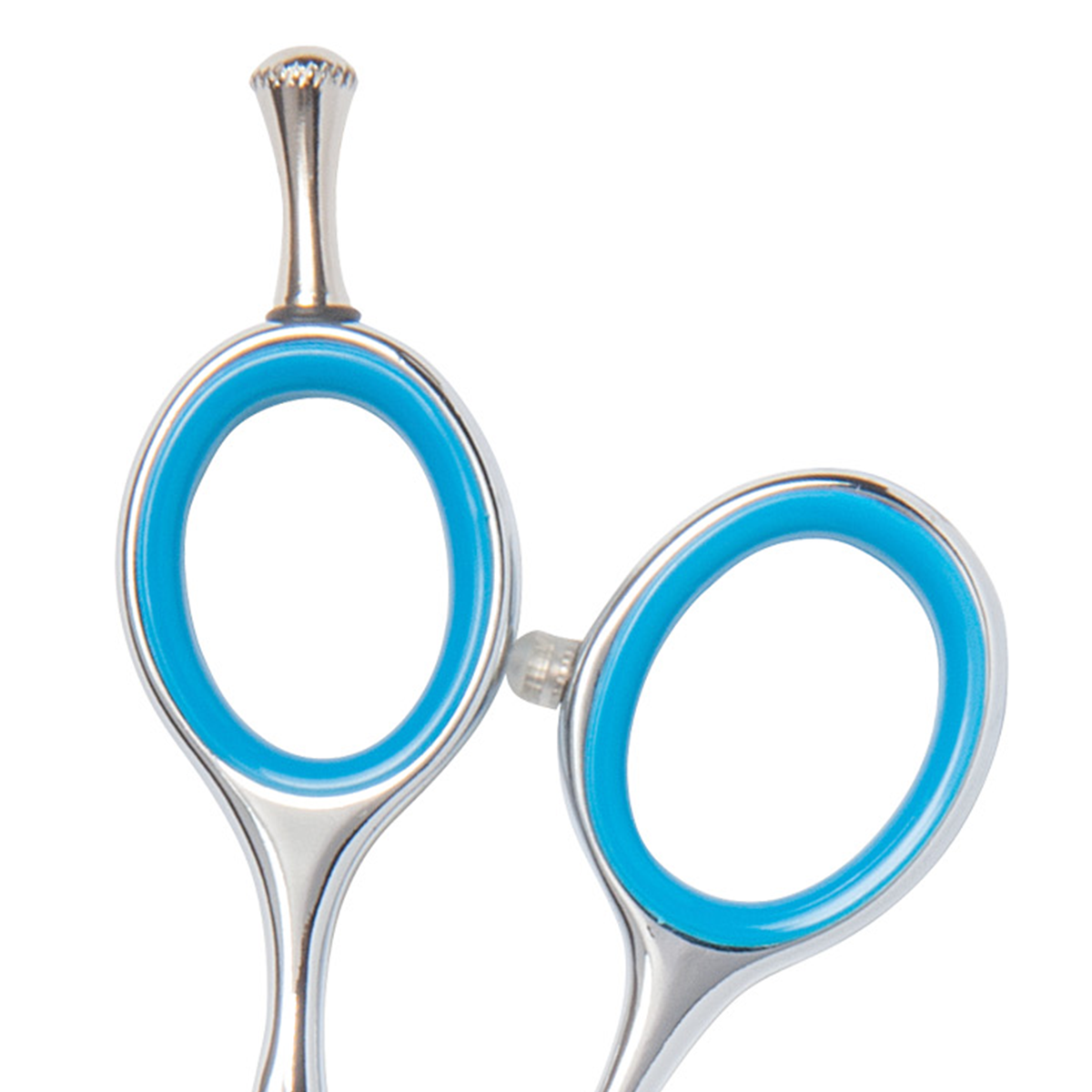
Thumb Ring Types
- Standard or flat
- Removable
- Angled
-
Swivel - offers the most natural thumb positioning

Bumpers
- Placed between the finger rests
- Designed to protect and silence shears
-
Removable and replaceable

To customize your fit, some shears offer finger rings and/or a tang.
Check out our Pro2Pro article on ergonomic hair tools to learn more about which handle fits best in your wrist’s natural posture.
Adjustment Screw on Salon Shears
The adjustment screw on each pair of professional shears allows you to automatically adjust the tension between the handle and blade. Try holding your shears upright vertically. If the tension is correct, the blade with the finger rest will drop one-third to one-half-way down. If needed, you can turn the adjustment screw to the right or left to tighten or loosen the tension.
Caring for Your Cutting Shears
Salon shears will last longer and perform to expectations when you follow a maintenance routine that includes daily cleaning. You can also protect your shears by placing them in a closed position on a towel as you style.
DO NOT CUT these with shears:
- Paper, nylon, plastic or other materials
- Hair that has a treatment in it, such as perm solution
-
Hair that has product in it, like hairspray
Routine Maintenance
In addition to following the manufacturer’s instructions, here are some tips to remember when maintaining your hair-cutting shears:
- Check the tension periodically
- Store in the closed position in the case
- Don’t place on or near objects that could damage the blades
-
Each week, place a drop of oil on a blade, then open and close the shears several times. Wipe away any excess oil with a soft cloth
Cleaning Options
As a first step in cleaning, carefully remove all the hair from the shears. Next, choose a cleaning method:
- Pour 2oz (1/4 cup) of Barbicide concentrate into 32oz (4 cups) of cold water
- Implements and surface must stay moist with Barbicide for 10 full minutes
- Clean with Clippercide spray
-
Use a heated sanitizer for cleaning
Shield Shears
Protect your shears by knowing how damage occurs. For example, when blades are exposed to hair styling products, corrosion can occur. Even soaking your shears in a liquid for more than 10 minutes could cause damage. Try to avoid accidental drops, and only use your shears to cut wet or dry hair. Be sure to review the care guidelines that come with your tool for additional maintenance practices.
Blade Sharpening for Shears
You should have your shears professionally sharpened at least once a year, though the amount of cutting you do will determine how often they need sharpening. It’s a good idea to check your shears every three months to see if sharpening is required. When it’s time for service, choose a professional affiliated with a reputable company. Sharpening is a specialized craft, and one bad job could damage your tool.
Specialty Shears
In addition to haircutting shears, you probably want specialty shears for styling. Thinning and texturizing shears are specialty tools that have a serrated-edge blade for specific results.
Thinning Shears
- Also called blending shears
- Feature blade teeth separated by small spaces
- Used to add texture to hair or blend hair ends
-
Can remove bulk from thick hair
Texturizing Shears
- Have wider spaces between blade teeth
- Create a noticeable texture effect
-
Used to add lift to a style and remove selective bulk

Marlo Beauty carries a variety of texturizing and thinning shears.
Why Choose High Quality Professional Hair Cutting Shears?
High-quality shears can be expensive, but they are worth the investment. A pair of quality shears for the salon can be a business asset that positively affects results and keeps your hand comfortable during a long day of cutting. If you’re choosing higher-end shears, make sure you get superior features plus ergonomic benefits. By learning more about these essential salon tools, you’ll be a smart buyer who’s happy with your business investment.
Frequently Asked Questions about Hair Cutting Shears
Dry Cutting Shears vs Wet Cutting Shears?
Dry cutting can help with visualizing and polishing the finished result, while wet cutting can offer crisp, clean lines. Can you use wet cutting shears for a dry cut? The easy answer is yes. The type of metal used for the blades will prevent corrosion when properly cared for, but cleaning them between haircuts will ensure their longevity.
How to Disinfect Hair Cutting Shears?
Remove hair and debris using a cloth or brush, then wash with warm, soapy water. Submerge tools in a disinfectant solution like Barbicide for 10 minutes, rinse thoroughly and dry completely. For non-submersible tools, use disinfectant sprays or wipes, ensuring full coverage.
How to Measure Hair Cutting Shears?
To measure the blade length, use a tape measure from the tip of the blade to the screw holding the two pieces together. Shears are typically measured in inches, with sizes ranging from 4.5" to 7", though 5.5" and 6" are most common for hairdressers and barbers.
Do Professionals Have to Sharpen Shears?
Yes, professionals need to sharpen their shears regularly to maintain performance and prevent client discomfort. For those cutting 6 to 8 wet-haired clients daily using Japanese steel and convex-edged scissors, sharpening is recommended every six months, while for dry hair cutting, every four months is advised.
Cast Shears vs. Forged Shears
Cast shears are made by pouring molten steel into a mold, resulting in a less expensive but more fragile product with potential air pockets. Forged shears are developed by pressing or hammering metal into shape, creating a denser, stronger and longer-lasting tool that can be made sharper and hold an edge longer.
SHOP MARLOBEAUTY.COM FOR SHEARS AND MORE
At Marlo Beauty Supply, we're dedicated to helping licensed salon professionals succeed. Our Pro2Pro page is designed to offer educational resources, advice and share news with industry insiders. If you're in the market, don't hesitate to check out our selection of quality and affordable professional shears, discounted for licensed beauty pros.
| SHOP: | www.marlobeauty.com |
| SHARE: |
|
